 English
Introduction
Choosing the right power stack supplier is an important step in developing power conversion systems for energy storage, solar, wind applications. A suitably integrated power stack can simplify converter design and assembly by combining semiconductor switching devices with supporting electrical, thermal, and mechanical components in a pre-assembled power unit.
Because product configurations, published specifications, and documentation dates vary, buyers should verify the latest model-specific datasheets and obtain written technical and commercial confirmation before making a procurement decision.
What Is an Power Stack?
A power stack is an integrated power conversion assembly designed for use in systems such as power conversion systems (PCS), photovoltaic inverters, wind power converters. Depending on the design and integration scope, it may combine IGBT/SiC modules, gate drivers, DC-link capacitors, laminated busbars, heatsinks, sensors, and mechanical components into a pre-assembled power unit.
A standalone IGBT module is a semiconductor switching component, whereas a power stack integrates power semiconductors with supporting electrical, thermal, and mechanical components. The scope of integration varies by supplier and product family. Buyers should therefore confirm the bill of materials, included components, interfaces, and supply responsibilities before comparing quotations.
For PCS manufacturers and power electronics engineers, selecting a power stack involves more than comparing semiconductor ratings. Key considerations include the DC-link operating range, AC output voltage and current, cooling requirements, mechanical interfaces, insulation, testing and validation, customization options, and delivery commitments.

How This Comparison Was Prepared
This comparison is based on publicly available company and product documentation cited in the source list. No independent laboratory testing, hands-on product evaluation, or supplier audit was conducted. Information not established by the sources reviewed is identified as “not stated in the reviewed sources” rather than inferred.
The comparison considers the following criteria:
· Electrical ratings: Published AC and DC voltage, current, and power ratings, where available, with attention to model-specific configurations and stated operating conditions.
· Cooling: Air-cooling, liquid-cooling, and other cooling arrangements explicitly described in the cited product documentation.
· Testing: Whether final testing is stated.
· Customization: Whether the supplier explicitly describes customized power stacks or turnkey assembly solutions.
· Lead time: Whether specific lead-time information is published and available for comparison.
The products reviewed belong to different product families and may be documented under different technical conditions and publication dates. Their published ratings should therefore be treated as product-specific examples, not directly equivalent performance benchmarks. Historical documentation does not establish current product availability.
Buyers should confirm the latest technical specifications, product status, test scope, customization options, and commercial terms directly with each supplier before procurement. The order of the supplier profiles is for presentation purposes only and does not represent an independently verified performance ranking.
Power Stack Manufacturers Compared
1. Firstack
Firstack Technology was established in 2011 in Hangzhou and focuses on power semiconductor drivers, power stacks, and test equipment. Its company profile reports more than 150 intellectual property rights.
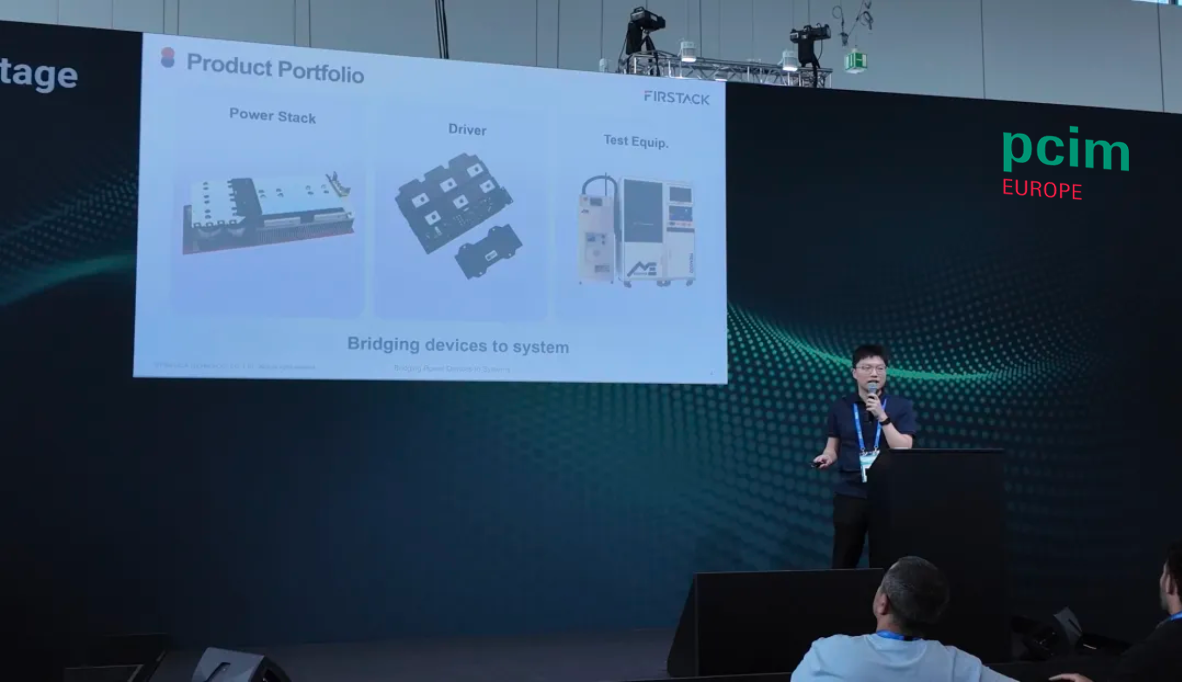
Its published standard power stack range lists nine models, with the following overall ranges:
- AC voltage classes: 380 V, 690 V, and 3300 V.
- Output current: 360 A to 2160 A.
- DC voltage: 800 V to 5000 V.
- Cooling: forced air, air, or liquid, depending on the model.
Examples listed on the product page include:
- FPS160HA124XA002: 690 V, 1600 A, 1500 V DC, air-cooled; listed for energy storage and photovoltaic applications.
- FPS210HA124TW004: 690 V, 2100 A, 1500 V DC, liquid-cooled; listed for photovoltaic, wind, and energy storage applications.
- FPS080HB451XW001: 3300 V, 800 A, 5000 V DC, liquid-cooled; listed for wind and motor-drive applications.
Firstack states that every power stack receives 100% unit final testing, that more than 100,000 units operate in demanding applications in China, and that custom turnkey stacks are available. The company describes lead times as minimal but does not publish specific delivery figures in the cited material. Buyers should confirm current model availability, configuration details, and delivery schedules directly.
Potential fit: buyers evaluating pre-assembled power stacks for wind, photovoltaic, energy storage, and motor-drive converters, particularly where gate-driver and power-stack integration are relevant.
2. Semikron Danfoss
Semikron Danfoss was formed in 2022 through the merger of SEMIKRON and Danfoss Silicon Power. Its power electronic stack portfolio includes water-cooled SEMISTACK RE assemblies, air- and water-cooled IGBT stack platforms, diode/thyristor stacks, and customized turnkey solutions.
The SEMISTACK RE is a pre-qualified, water-cooled power assembly based on SKiiP intelligent power modules (IPMs). According to the manufacturer's product information, it is designed for megawatt-class, low-voltage power conversion applications, with platform capability of up to 6 MVA. The published specifications include 1250 V nominal DC operation and B1 and B2 housing sizes. Listed applications include wind energy, green hydrogen, solar and energy storage systems, and motor drives.
For 1500 V DC applications, the SEMISTACK RE SiC version uses 2 kV SiC technology to support a two-level converter topology. The manufacturer's SiC product documentation lists 100% burn-in testing for SEMISTACK RE SiC. This statement applies to the specified SiC stack offering and should not automatically be generalized to every SEMISTACK RE configuration.
Potential fit: Megawatt-class renewable-energy and industrial converter projects that match the platform's electrical and thermal requirements. Before selecting a configuration, confirm the exact model, DC operating range, AC output requirements, cooling interface, test scope, and current product availability with the supplier.
3. Infineon
Infineon has offered high-power IGBT stack solutions under its ModSTACK product family. Historical product documentation lists ModSTACK C at 600 kW to 1.2 MW, ModSTACK 3 at 800 kW to 3.0 MW, and ModSTACK HD at 600 kW to 8 MW, depending on configuration and parallel operation. The published product family includes forced-air and liquid-cooled solutions.
Historical ModSTACK HD technical documents describe selected configurations using 1700 V IGBT modules for converter applications with AC voltages up to 690 V RMS. Listed configurations include rated output currents from 1200 A to 2050 A RMS, liquid cooling, and integrated current, voltage, and temperature sensing. Wind power and motor drives are among the documented applications. These ratings apply to specific configurations and operating conditions, rather than universally to every ModSTACK HD unit.
The technical documents reviewed date from earlier product generations, including publications from 2013 and 2017. The available sources do not establish the current availability of the complete ModSTACK stack product family. They also do not provide sufficient evidence to make a general claim about stack-level factory testing or customization across the range.
Potential fit: High-power wind and industrial motor-drive converter designs that match the documented electrical and thermal specifications. Because the available documentation is historical, buyers should confirm current product availability, supported configurations, the latest technical documentation, stack-level testing, and customization options directly with Infineon before shortlisting the product.
Quick Comparison
The table below condenses the profiles above using the same five ranking factors.
Supplier | Specifications | Cooling | Testing | Lead time | Customization |
380/690/3300VAC 360–2160 A 800–5000 V DC | Air or liquid | 100% unit final testing | Described as minimal; no figures | Custom turnkey stacks | |
Semikron Danfoss | SEMISTACK RE: up to 6 MVA 1250 V DC nominal | Water (RE); air-cooled IGBT stacks also listed | 100% for SKiiP modules | Not stated | Customized stacks listed |
Infineon | ModSTACK HD: 600 kW–8 MW up to 690 V RMS | Forced air or liquid | Not stated | Not stated | Not stated |
Notes: The specifications above are examples from different product families and document dates; they are not directly comparable performance ratings. “Not stated in the reviewed sources” means that the available documents do not establish the information, not that the supplier lacks the capability. Historical specifications do not confirm current product availability. Buyers should verify the exact model, operating conditions, test scope, customization requirements, and delivery schedule directly with the manufacturer.
How to Choose a Power Stack for Your Application
Wind Power Converters
For wind power converters, evaluate the required AC voltage and current, DC-link operating range, converter topology, switching frequency, thermal performance, and cooling requirements. Liquid cooling may be appropriate for high-power designs, but the choice should be based on the actual losses and thermal constraints.
Firstack lists wind power converter applications for multiple power stack models, including the FPS088T172W001, specified at 690 V AC, 880 A AC, and 1150V DC-bus voltage. SEMIKRON DANFOSS specifies SEMISTACK RE for wind turbine applications. Historical Infineon ModSTACK HD documentation also identifies wind power as an application. These published application descriptions do not establish suitability for every wind converter design; confirm the complete electrical and thermal operating envelope for the intended application.
Photovoltaic Inverters
For photovoltaic inverters, match the stack's DC operating range and AC output requirements to the selected inverter topology. Check the maximum and minimum DC-link voltage, rated AC voltage and current, switching frequency, overload requirements, and cooling conditions. A stated DC voltage rating should not be treated as interchangeable with a semiconductor blocking-voltage rating.
Firstack publishes power stack models for photovoltaic applications,including products with 1500 V full DC-bus ratings. SEMIKRON DANFOSS lists solar applications in its power stack portfolio; however, the SEMISTACK RE product page specifies 1250 V nominal DC operation, which should not be interpreted as a universal 1500 V DC rating. SEMIKRON DANFOSS separately describes 2 kV SiC device technology for certain 1500 V DC, two-level converter applications. Confirm the exact stack model and operating limits before selection.
Energy Storage Power Conversion Systems (PCS)
For energy storage PCS applications, verify the battery-side DC voltage range, AC grid voltage, continuous and overload current, converter topology, cooling conditions, protection interfaces, and mechanical integration requirements. Also assess whether the stack's electrical ratings and thermal design support the required charge/discharge duty cycle.
Firstack lists energy storage applications for several power stack models, including the FPS210HA124TW004, listed at 690 V AC, 2100 A AC, and 1500 V full DC-bus voltage. SEMIKRON DANFOSS identifies solar and energy storage systems as applications for its power electronics portfolio, which includes ready-to-use power stacks. These application listings indicate relevance to the sector, but do not establish compatibility with a specific PCS design. Request the exact model datasheet and written confirmation of operating limits, protection interfaces, and required duty-cycle performance.
Power Stack Supplier Selection Checklist
Before requesting a quotation, prepare a standardized technical specification so that suppliers can evaluate the same requirements and provide comparable proposals.
1. Electrical Ratings and Operating Conditions: Specify the minimum, nominal, and maximum DC-link voltage; rated AC output voltage; continuous and peak current; rated power; overload capability; switching frequency; and operating duty cycle. Identify the converter topology and any application-specific operating conditions.
2. Assembly Scope and Bill of Materials: Clearly define the required power stack integration level, including IGBT modules or other power semiconductors, gate drivers, DC-link capacitors, laminated busbars, heatsinks, current and temperature sensors, mechanical frames, and cooling interfaces. Identify which components are supplied by the customer and which must be included in the supplier's scope.
3. Cooling and Thermal Requirements: Specify air or liquid cooling, coolant type and operating conditions where applicable, allowable pressure drop, required thermal performance, interface requirements, and installation constraints. Define the relevant ambient temperature and maximum allowable component or coolant temperatures.
4. Mechanical, Electrical, and Control Interfaces: Provide mounting dimensions, terminal positions, busbar connection details, insulation and clearance requirements, protective-earth connections, and control and feedback interface specifications. Define connector types, signal levels, pin assignments, and relevant interface documentation where applicable.
5. Testing, Validation, and Documentation: Request the proposed factory acceptance test (FAT) plan and clarify the scope of functional tests, electrical safety checks, insulation tests, and thermal validation. Specify required test reports, acceptance criteria, traceability records, and any application-specific qualification requirements.
6. Customization and Engineering Support: Confirm which electrical, mechanical, thermal, and control-interface modifications are supported. Clarify design responsibility, engineering validation, prototype availability, minimum order quantities, non-recurring engineering (NRE) charges, and the approval process for design changes.
7. Supply, Quality, and Product Lifecycle: Confirm current product availability, prototype and production lead times, warranty terms, quality management requirements, change-notification procedures, and expected long-term supply support. Request details of component obsolescence management and the process for approving substitutions or design revisions.
RFQ recommendation: Attach the electrical specification, mechanical drawings, interface requirements, expected annual volume, project schedule, and required validation documents to the RFQ. Ask each supplier to identify deviations from the specification and clearly separate confirmed capabilities from items requiring further engineering evaluation.
Frequently Asked Questions
1. Is air cooling or liquid cooling better for a power stack?
Neither cooling method is universally better. The appropriate choice depends on power losses, current rating, ambient temperature, available space, acoustic constraints, and the system's thermal design.
Firstack's published product listings include forced-air-cooled models rated at 900 A and 1600 A, as well as liquid-cooled models rated at 1750 A, 2100 A, and 2160 A. These are examples of specific products, not defined current limits for either cooling method. Compare the thermal performance and cooling requirements of the exact models under the intended operating conditions.
2. How should AC and DC voltage ratings be matched?
AC output voltage and DC-link voltage describe different parts of the converter and must be assessed separately. For example, a published rating of 690 V AC and 1500 V DC bus applies to a particular product configuration; it does not establish compatibility with every converter using those voltage classes.
Check the minimum, nominal, and maximum DC-link voltage, AC voltage and current, converter topology, switching conditions, transient limits, and the rating definitions in the supplier's datasheet. Confirm that the complete operating envelope is suitable for the intended application.
3. Does a supplier's module-testing statement mean the complete stack has been tested?
No—not unless the supplier explicitly confirms that the statement applies to the complete power stack assembly. Testing of an individual IGBT or intelligent power module does not, by itself, establish that the assembled stack has undergone final functional or system-level testing.
Request the stack-level factory acceptance test (FAT) plan, test coverage, acceptance criteria, and applicable test reports. Clarify which tests are performed on individual components, subassemblies, and the complete power stack.
4. How can lead time and customization be confirmed?
Request a written quotation for the exact configuration, including prototype lead time, production lead time, order quantity, customization scope, engineering charges, and delivery commitments.
Public product information may describe customization capabilities without specifying delivery schedules or the engineering scope available for a particular project. Treat lead time and customization as project-specific commercial and technical commitments, and obtain written confirmation from the supplier.
5. What should be included in a request for quotation (RFQ)?
An RFQ should include the electrical ratings and operating envelope, converter topology, cooling requirements, mechanical drawings, electrical and control interfaces, required assembly scope, expected order volume, qualification requirements, and target delivery schedule.
Also specify the required factory tests, documentation, acceptance criteria, and any customization requirements. Ask suppliers to identify deviations from the specification and distinguish confirmed capabilities from items requiring further engineering evaluation. This makes technical and commercial proposals easier to compare on an equivalent basis.
Conclusion
Firstack, Semikron Danfoss, and Infineon have published power stack solutions for selected high-power conversion applications, but their product portfolios and available documentation differ.
Firstack's published product information provides model-specific electrical ratings, cooling options, and a supplier-stated 100% final-testing claim. Semikron Danfoss offers a range of power stack platforms, including SEMISTACK RE for megawatt-class applications. Historical Infineon ModSTACK documentation describes high-power configurations, but current product availability should be confirmed directly with the manufacturer.
Selecting the right supplier requires more than comparing headline power ratings. Buyers should evaluate the complete electrical operating range, cooling and mechanical requirements, assembly scope, stack-level validation, customization options, and supply commitments.
Use this guide to identify potential suppliers, then verify the latest model-specific documentation and obtain written technical and commercial proposals. Before placing an order, confirm that the proposed assembly meets the requirements of the intended PCS, photovoltaic inverter, wind converter, energy storage system, or industrial motor drive.
Sources
• Firstack – Power Stack: https://www.firstack.com/products/power-stack/
• Firstack – Company: https://www.firstack.com/about-us/introduction.html
• Semikron Danfoss – SEMISTACK RE: https://www.semikron-danfoss.com/products/power-electronic-stacks/power-electronic-stacks-by-product-line/semistack-re
• Semikron Danfoss – About Semikron Danfoss: https://semikron-danfoss.com/about-semikron-danfoss
• Semikron Danfoss – Power module and stack brochure (SKiiP, SEMISTACK RE SiC): https://assets.danfoss.com/documents/latest/472443/AD506437902420en-000201.pdf
• Infineon – ModSTACK product brief: https://wmsc.lcsc.com/wmsc/upload/file/pdf/v2/lcsc/2304140030_Infineon-Technologies-2LS20017E42W34854_C533092.pdf
• Infineon – ModSTACK HD technical information 6MS20017E43W37032: https://wmsc.lcsc.com/wmsc/upload/file/pdf/v2/lcsc/2005291107_Infineon-Technologies-6MS20017E43W37032_C533119.pdf
• Infineon – ModSTACK HD technical information 6MS30017E43W34404: https://wmsc.lcsc.com/wmsc/upload/file/pdf/v2/lcsc/2005291107_Infineon-Technologies-6MS30017E43W34404_C533126.pdf
• Infineon – ModSTACK HD technical information 6MS30017E43W38169: https://wmsc.lcsc.com/wmsc/upload/file/pdf/v2/lcsc/2005291107_Infineon-Technologies-6MS30017E43W38169_C533127.pdf
• Infineon – Annual Report 2025: https://www.infineon.com/row/public/documents/corporate/investors/annual-reports/2025/2025-annual-report-v01-00-en.pdf

