 English
Power electronics plays a central role in modern energy systems, industrial automation, transportation, and electrical infrastructure. From converting solar-generated electricity into grid-compatible power to controlling the speed of industrial motors, these applications depend on reliable equipment that manages electrical energy efficiently. Understanding power conversion solutions and the role of gate drivers helps engineers and system integrators design equipment that meets demanding performance, safety, and reliability requirements.
What Are Power Conversion Solutions?
Power conversion solutions are technologies and integrated systems that transform electrical energy from one form into another to meet the requirements of a particular application. Depending on the system, conversion may involve changing alternating current (AC) into direct current (DC), converting DC into AC, adjusting voltage levels, or regulating electrical power delivered to a load.
Common conversion technologies include rectifiers, inverters, DC-DC converters, and AC-AC converters. Rectifiers convert AC into DC, while inverters perform the reverse operation. DC-DC converters adjust DC voltage, and AC-AC converters modify characteristics such as voltage or frequency. Engineers select the appropriate topology according to input conditions, output requirements, operating environment, and efficiency targets.
Modern power conversion solutions also depend on control circuits, power semiconductor devices, cooling arrangements, protection mechanisms, and system monitoring. These elements work together to manage switching behavior, limit electrical stress, and maintain stable operation under changing loads.
Where Are Power Conversion Solutions Used?
The applications of power conversion extend across industries where electricity must be controlled, transferred, or used efficiently.
In renewable energy, solar inverters convert DC electricity from photovoltaic panels into AC power suitable for grid connection or local consumption. Wind power converters regulate the electrical output of wind turbines and support grid integration. Energy storage systems use bidirectional conversion equipment to manage charging and discharging between batteries and AC electrical networks.
Rail transportation relies on power electronics for traction systems, auxiliary power supplies, and other electrical functions. Industrial motor drives regulate motor speed and torque, helping production equipment respond to different operating demands. Power transmission and distribution systems also use converter technology in applications that require controlled power flow and voltage management.
These industries differ in operating conditions, but their requirements often overlap: dependable switching, thermal management, electrical protection, and consistent performance throughout the equipment's service life.
Where Does an IGBT Gate Driver Fit In?
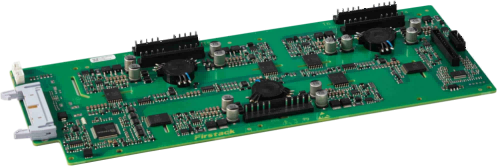
An insulated-gate bipolar transistor (IGBT) is a power semiconductor commonly used in medium-power and high-power switching applications. It combines a voltage-controlled gate with bipolar conduction characteristics, making it useful in equipment such as industrial inverters, motor drives, and renewable energy converters.
An IGBT gate driver connects the low-power control circuitry with the power transistor's gate. A controller generates a switching command, but its output may not provide the voltage, current, isolation, or protection needed to operate the transistor directly. The driver conditions that command and supplies the gate-drive signal required for controlled switching.
The driver therefore forms an essential interface between system control and the power stage. Its design influences switching speed, losses, electromagnetic interference, and the ability to respond to abnormal operating conditions. Gate drivers do not convert the main electrical power themselves; instead, they help power semiconductor devices perform that conversion as intended.
Key Functions of a Gate Driver in Power Electronics
Gate drivers do more than transmit switching commands. Their functions must match the semiconductor device, circuit topology, and operating conditions.
Gate signal control: Appropriate drive voltage and current help the IGBT turn on and off as required.
Electrical isolation: Isolated driver designs can separate low-voltage control electronics from high-voltage power circuits, subject to the system's insulation requirements.
Fault protection: Depending on the design, protection functions may address short circuits, undervoltage, or abnormal switching conditions.
Switching optimization: Gate resistance and drive settings influence switching transitions, losses, and electromagnetic interference.
Thermal and system reliability: Suitable drive control helps manage device stress, while temperature monitoring and coordinated protection support reliable operation.
These functions must be balanced carefully. Faster switching can reduce switching losses but may increase voltage overshoot and electromagnetic interference. Engineers therefore need to evaluate switching waveforms, parasitic inductance, device characteristics, and protection response together rather than optimizing a single parameter.
How to Select the Right Gate Driver Solution
Selecting an IGBT gate driver starts with the semiconductor module and the application's electrical requirements. Engineers should confirm the required gate voltage, peak gate current, switching frequency, isolation rating, and compatibility with the selected module.
Protection capabilities deserve equal attention. Short-circuit detection, controlled shutdown, and undervoltage protection can help prevent damage, but their suitability depends on the device and system design. PCB layout, gate-loop inductance, cooling, and electromagnetic compatibility also affect actual performance.
Integration is another important consideration. A driver designed for a specific power module or converter topology can simplify development, while configurable solutions may provide greater flexibility across multiple designs. Engineers should evaluate the complete power stage, including the driver, semiconductor module, DC bus, cooling system, and control interface.
How Firstack Supports Power Electronics Development
At Firstack, we specialize in the research, development, and sales of power semiconductor drivers, power stacks, and testing equipment. Our solutions serve applications including renewable energy, rail transportation, power transmission, and motor drives, where dependable power electronics are essential.
Our gate driver portfolio includes core drivers, plug-and-play products, and configurable driver solutions designed to support different integration requirements. We also provide power stacks that bring key power-stage components together, helping customers address system integration and development challenges. Product selection should always reflect the application's technical requirements rather than relying on general performance claims alone.
Testing is equally important when developing reliable equipment. Double-pulse testing helps engineers evaluate dynamic switching characteristics and assess parameters such as switching energy and voltage or current transitions. At Firstack, our testing equipment supports the evaluation of IGBT and silicon carbide (SiC) power devices during research, development, and application testing. These evaluations help engineers refine gate-drive parameters and validate designs under defined test conditions.
Building More Reliable Power Conversion Systems
Effective power electronics design requires coordination between semiconductor devices, control circuits, gate drivers, protection functions, and thermal management. Understanding these relationships helps engineers make informed decisions about efficiency, reliability, and integration.
At Firstack, we support power electronics development through driver technologies, power stacks, and testing equipment. By evaluating the complete system and selecting an appropriate IGBT gate driver for its operating conditions, engineering teams can build a stronger foundation for dependable energy conversion across industrial and infrastructure applications.

